Our Crystals
Four crystals. Endless applications.
Silicon
The backbone of the global semiconductor industry
About Silicon
Silicon single crystals form the substrate for 95% of the world's integrated circuits, solar cells, and power electronics. Grown by the Czochralski method at 1420 °C, a single flawless boule - pulled over 48 hours from a bath of molten Silicon - becomes the foundation for thousands of chips. India imports 100% of its semiconductor-grade Silicon. Indigenous production is now changing that.
Strategic Importance
Why Silicon matters & what RSPL is doing
India imports 100% of its semiconductor-grade Silicon - every chip fabrication facility depends entirely on foreign wafers.
The India Semiconductor Mission targets domestic chip fabrication by 2027 - without indigenous wafers, every fab remains import-dependent.
Silicon is the first link in the semiconductor value chain - and has been entirely missing from India's industrial base.
RSPL has grown India's first 200 mm Silicon single crystal boule using the Czochralski method - a milestone for any Indian private entity.
RSPL's Silicon Programme
Operating under the BARC Technology Transfer MOU, RSPL's Czochralski Silicon growth facility produces 150 mm boules for power electronics and 200 mm boules for logic and memory substrate qualification - breaking India's complete dependence on foreign suppliers for the most critical substrate material in electronics.
Applications & Use Cases

Semiconductor Fabrication
Foundational substrate for CPUs, GPUs, memory chips, and logic ICs - powering every digital device from smartphones to supercomputers.

Solar Energy
Monocrystalline Silicon cells deliver the highest efficiency in commercial PV modules, driving India's solar energy expansion.

Power Electronics
Enables MOSFETs, IGBTs, and thyristors used in electric vehicles, power grids, and industrial motor drives.
Germanium
Critical IR semiconductor - the backbone of night vision, defence optics, and next-gen solar
About Germanium
Germanium (Ge) is a silvery-white semiconducting metalloid with exceptional transparency in the 2-14 μm infrared range, making it irreplaceable for thermal imaging lenses, FLIR systems, and missile seeker optics. China controls over 80% of global Germanium supply - a critical chokepoint for India's defence and space programmes. India's first indigenous Ge crystal growth and wafer capability is now being established.
Strategic Importance
Why Germanium matters & what RSPL is doing
India imports 100% of its Germanium - every FLIR system, night vision device, and thermal camera in the Armed Forces depends on foreign supply.
Recent export restrictions by the dominant global supplier directly threatened India's access to IR-grade optics for defence systems.
Germanium substrates are essential for multi-junction solar cells powering India's space satellites - every mission depends on imported Ge wafers.
RSPL is establishing India's first end-to-end Ge crystal growth programme under the India Semiconductor Mission and BARC incubation.
RSPL's Germanium Programme
Through the BARC Atal Incubation Centre, RSPL gains access to decades of detector-grade Germanium research, zone refining infrastructure for 6N+ purity, and a direct DRDO qualification pathway. The programme targets IR-grade Ge blanks for thermal imaging systems and detector-grade material for nuclear and scientific applications - making India self-reliant for this critical defence material.
Applications & Use Cases

Night Vision & Thermal Imaging
Germanium lenses enable FLIR cameras and night vision for surveillance, targeting, and navigation by the Indian Armed Forces.
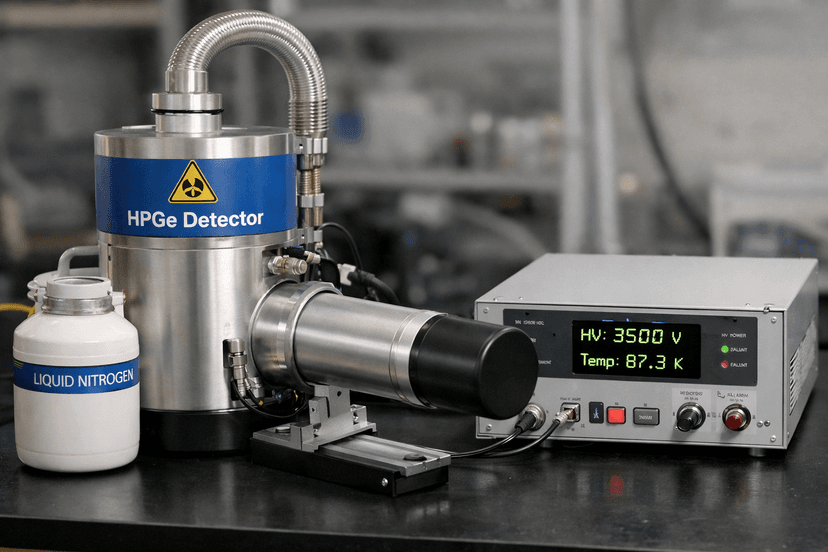
Nuclear & Scientific Detection
HPGe detectors provide unmatched energy resolution for gamma-ray spectroscopy in nuclear physics, medical imaging, and homeland security.

Space Solar Cells
Ge substrates enable multi-junction III-V solar cells delivering 30%+ efficiency for satellites - far exceeding Silicon-based cells.
Lithium Niobate
The crystal powering 5G filters, electro-optic modulators, and next-generation telecom
About Lithium Niobate
Lithium Niobate (LiNbO₃) is a multifunctional oxide crystal with exceptional piezoelectric, electro-optic, and nonlinear optical properties. It is the backbone of modern high-frequency filters in 5G smartphones, optical modulators in fibre-optic networks, and acoustic wave sensors. Global demand has surged with 5G rollout - and India imports every single wafer.
Strategic Importance
Why Lithium Niobate matters & what RSPL is doing
India imports every single LiNbO₃ wafer - 100% import dependency for a material critical to 5G rollout.
Every 5G smartphone contains 40-100 LiNbO₃-based SAW/BAW filters - India's 5G expansion creates massive demand with zero domestic supply.
LiNbO₃ electro-optic modulators are critical to India's defence fibre-optic communication infrastructure and emerging quantum networks.
Global supply is concentrated in a handful of nations, all subject to export controls - making domestic production a strategic imperative.
RSPL's LiNbO₃ Programme
RSPL is growing congruent and near-stoichiometric LiNbO₃ single crystals using the Czochralski method - the first such capability in India. Working under the iDEX framework with DRDO, the programme targets SAW-grade wafers (3-inch and 4-inch) for India's 5G component ecosystem and electro-optic grade material for indigenous defence communication systems.
Applications & Use Cases

Quantum Photonics
Nonlinear optical properties make LiNbO₃ essential for quantum key distribution, entangled photon sources, and next-generation secure networks.

Fibre-Optic Networks
Electro-optic modulators encode data onto light at speeds exceeding 100 Gbps - the backbone of India's telecom infrastructure.

Neuromorphic Computing
LiNbO₃ photonic chips enable brain-inspired computing architectures, using light instead of electrons for ultra-fast, energy-efficient AI inference and pattern recognition.
Nd:YAG
The gain medium powering India's defence laser systems
About Nd:YAG
Neodymium-doped Yttrium Aluminium Garnet (Nd:YAG) is the world's most widely used solid-state laser gain medium. It powers range finders, target designators, and directed energy weapons across every major military. The crystal emits at 1064 nm when pumped, producing pulses with nanosecond precision. India imports 100% of its Nd:YAG crystals. Indigenous production under the iDEX programme is ending that dependency.
Strategic Importance
Why Nd:YAG matters & what RSPL is doing
India imports 100% of its Nd:YAG crystals - classified as a dual-use controlled export by supplier nations.
Every range finder, target designator, and laser system in the Indian Armed Forces requires Nd:YAG - a supply cut directly impairs defence capability.
70% of global supply is controlled by a single nation that can restrict exports at any time - making this a national security vulnerability.
RSPL, under the iDEX DISC X programme with DRDO, has demonstrated defence-qualified Nd:YAG crystals - eliminating this critical dependency.
RSPL's Nd:YAG Programme
RSPL has demonstrated 25 mm diameter laser-grade Nd:YAG crystals with fluorescence lifetime of 230 μs and Nd concentration uniformity of ±3%. DRDO qualification tests confirmed 120 mJ output at 1064 nm in Q-switched operation - meeting specifications for defence range finders and target designators. Production rods are available for Indian defence system integrators.
Applications & Use Cases

Defence Laser Systems
Gain medium in laser range finders and target designators - enabling precise targeting at distances exceeding 10 km.

Medical Applications
Ophthalmology (posterior capsulotomy), dermatology (tattoo removal, skin resurfacing), and dental procedures.

Industrial Manufacturing
Precision cutting, welding, and drilling of metals, ceramics, and composites in automotive and aerospace manufacturing.
Need a custom crystal for your application?
We supply to semiconductor labs, defence organisations, and research institutions across India - with custom orientations, dopant levels, and sizes.